A successful attack can be the end of a volley. Power and accuracy are both key components in a good hit. The basics:
Transition off the net (will be covered later in this section) on an angle. When the setter sets the ball, begin your spike approach. A spike approach consists of four steps:
Right
Left
Right
Left
The first step is just a quick tap, while the second is a large step. The third and fourth steps are in quick succession, right after each other. Doing a correct spike approach will allow you to jump HIGH and spike the ball POWERFULLY. It will also stop you from going into the net.
Lefties:
You do the opposite spike approach.
Left
Right
Left
Right
As you jump, open your arms into a bow and arrow (dominant hand back). Torc (twist) as the ball contacts your palms and SNAP your wrists to add topspin.
That's all for today. Transitioning is going to be covered shortly. Come back for more volleyball tips, volleyball skills, volleyball training, and volleyball techniques.
-Stanupa
January 6, 2010


January 4, 2010
How to Improve Your Game - Setting
VOLLEYBALL TECHNIQUES for SETTING
Setting
A good set leads to a great attack. Setting is anything before the attack, yet it is usually the second contact on a side. A set can be a bump-set, an overhand set, a pancake set, and really anything. Lets start with proper setting position.
______
Where do you stand when you set?
When you set, you are to set perpendicular to the net, to the right of the court, and finally above the 10 foot line. This gives you a very good position to set to the outside hitter (I will refer to them as OH) and to a middle (They are sometimes refered to as "2 sets") to allow for powerful attacks.
______
A word of caution: Don't get too used to bump sets. You need to practice hand setting before you can start mastering bump sets.
_____
I hope you enjoyed this article on Improving Your Game - Setting! More tips on volleyball techniques, volleyball training, and volleyball skills soon!
- Stanupa
Setting
A good set leads to a great attack. Setting is anything before the attack, yet it is usually the second contact on a side. A set can be a bump-set, an overhand set, a pancake set, and really anything. Lets start with proper setting position.
______
Where do you stand when you set?
When you set, you are to set perpendicular to the net, to the right of the court, and finally above the 10 foot line. This gives you a very good position to set to the outside hitter (I will refer to them as OH) and to a middle (They are sometimes refered to as "2 sets") to allow for powerful attacks.
______
Overhand Sets
Overhand setting is the most common form of a set. When overhand setting you have the most control over where the ball goes. Here we go with the basics:- Open your palms and fingers up but keep them relaxed.
- Put the opened hands over your head like "moose antlers". Make a triangle with your thumb and pointer fingers
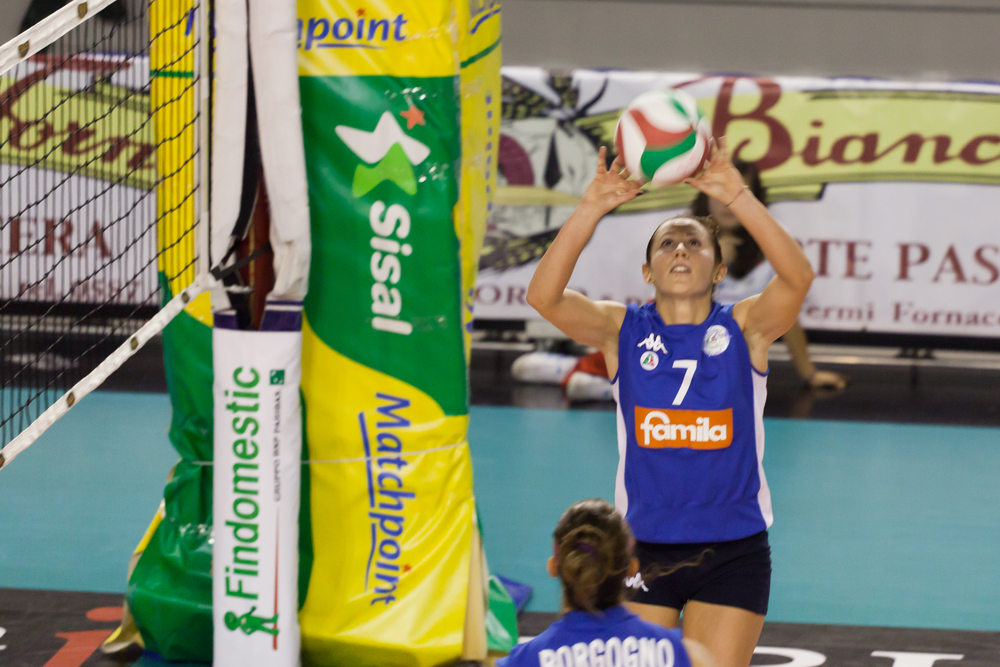
- Get low and extend your arms and push up as the ball enters your "triangle". Let the ball come in and out without carrying it.
- Face where the ball is coming from and then step with your opposite dominant foot into where you want it to go.
- Keep your hands relaxed! It will definitely help your control. Setting is much more difficult when a ball is bouncing off your fingers.
Bump Set
The bump set is a great pass in a moderate emergency, if you cannot overhand set the ball in time. It is to only be used in case you cannot reach the ball. The procedure for bump sets are the same as a normal bump, except instead of passing to a setter, you are passing to a hitter.A word of caution: Don't get too used to bump sets. You need to practice hand setting before you can start mastering bump sets.
_____
Where should I set to?
There are a few different places you want to set to depending on what hitter you are setting to. For Outside Hitters (OH):- At almost the total end of the net, but not so much that your hitter has trouble hitting it.
- Set a nice amount of space off the net, 3-4 feet on average. This prevents the hitter from running into the net.
- Just set UP and right in front of you. Set about 8-9 feet in height.
- Set about 5 feet off the ten foot line.
- Do not set anywhere in front of the 10 foot line, as back row hitters should not be going in front of it for any purpose.
- Set about 10-12 feet in height.
I hope you enjoyed this article on Improving Your Game - Setting! More tips on volleyball techniques, volleyball training, and volleyball skills soon!
- Stanupa
January 3, 2010
How to Improve Your Game - Passing
So you're a hardcore volleyball player. You want to improve your game, huh? Well you've certainly come to the right place. We'll go ahead and start with passing.
_____
A good athletic (ready) stance can improve your passing ten-fold. A good ready stance is the following:

Ready Stance:
Bend your knees slightly, your feet shoulder width apart. Shift and carry your weight on the bottoms of your feet while resting your hands on your lower thigh, near your knee cap. When the ball is contacted on the other side of the net, split step. A split step is simply just spreading your feet apart and letting your hands dangle. A good split step speeds up your pass by allowing you to shuffle to the ball faster.
_______
Passing. Possibly the most important element of Volleyball. Without a good pass, there cannot be a powerful attack. Lets start with the basics.
Bump:
Start in your ready stance and wait for the ball to be contacted. As soon (or even earlier) as the ball is contacted, split step and shuffle towards the ball. Call it (mine mine mine!) and connect your arms together into a platform. If you are a righty, put your right hand over your left and put your thumbs together. Lefties, you know you guys are special :P. I myself am a righty, but I pass the lefty way. As a lefty you put your left hand over your right. When you have your platform ready, do a simple movement. A simple movement is simply just a little push up. However, do NOT swing your arms. Use your legs and push your body up.
That seems easy, right? Perfecting your passes can take many years of experience. Getting it right on the first try is not going to happen.
____
Digging. The correct response from a back row player from an attack.
Dig:
Almost the exact same procedure as a bump, except you want to eliminate ANY movement or arm swing. When you go to pass the ball you needn't move at all. Allow the ball's kinetic energy to bounce it to your target without any of your energy being spent. Allow the ball to bounce off your arm. Tilt your shoulder to your passer, which is almost always (99%) to your right.
____
Have you ever noticed it is much harder to pass to your setter on the right when you pass from the right side of your body? That's because it is. Volleyball players use this motto to help them remember which way to pass:
Left is Right, Right is Wrong:
This is exactly what it sounds like. You are never supposed to pass from your right side to the setter on your right. It makes it much, much harder to give a good pass. Plus, the person to your right could have passed it much easier from his left side.
You. Must. Pass. From. Your. Left. Side.
A.L.W.A.Y.S. unless you MUST MUST MUST pass from your right in an emergency.
_____
Tilting your Shoulder:
To pass to someone on either side of you, tilting your shoulder is the way to go. By tilting your shoulder, you in turn tilt your platform. Tilting the platform creates an angle in which the only place the ball can go is to where the platform is pointing.
________________
That's about it for now. Coming soon: How to Improve Your Game - Setting. Come back soon for more volleyball tips, volleyball skills, and volleyball training!
- Stanupa
_____
A good athletic (ready) stance can improve your passing ten-fold. A good ready stance is the following:

Ready Stance:
Bend your knees slightly, your feet shoulder width apart. Shift and carry your weight on the bottoms of your feet while resting your hands on your lower thigh, near your knee cap. When the ball is contacted on the other side of the net, split step. A split step is simply just spreading your feet apart and letting your hands dangle. A good split step speeds up your pass by allowing you to shuffle to the ball faster.
_______
Passing. Possibly the most important element of Volleyball. Without a good pass, there cannot be a powerful attack. Lets start with the basics.
Bump:
Start in your ready stance and wait for the ball to be contacted. As soon (or even earlier) as the ball is contacted, split step and shuffle towards the ball. Call it (mine mine mine!) and connect your arms together into a platform. If you are a righty, put your right hand over your left and put your thumbs together. Lefties, you know you guys are special :P. I myself am a righty, but I pass the lefty way. As a lefty you put your left hand over your right. When you have your platform ready, do a simple movement. A simple movement is simply just a little push up. However, do NOT swing your arms. Use your legs and push your body up.
That seems easy, right? Perfecting your passes can take many years of experience. Getting it right on the first try is not going to happen.
____
Digging. The correct response from a back row player from an attack.
Dig:
Almost the exact same procedure as a bump, except you want to eliminate ANY movement or arm swing. When you go to pass the ball you needn't move at all. Allow the ball's kinetic energy to bounce it to your target without any of your energy being spent. Allow the ball to bounce off your arm. Tilt your shoulder to your passer, which is almost always (99%) to your right.
____
Have you ever noticed it is much harder to pass to your setter on the right when you pass from the right side of your body? That's because it is. Volleyball players use this motto to help them remember which way to pass:
Left is Right, Right is Wrong:
This is exactly what it sounds like. You are never supposed to pass from your right side to the setter on your right. It makes it much, much harder to give a good pass. Plus, the person to your right could have passed it much easier from his left side.
You. Must. Pass. From. Your. Left. Side.
A.L.W.A.Y.S. unless you MUST MUST MUST pass from your right in an emergency.
_____
Tilting your Shoulder:
To pass to someone on either side of you, tilting your shoulder is the way to go. By tilting your shoulder, you in turn tilt your platform. Tilting the platform creates an angle in which the only place the ball can go is to where the platform is pointing.
________________
That's about it for now. Coming soon: How to Improve Your Game - Setting. Come back soon for more volleyball tips, volleyball skills, and volleyball training!
- Stanupa
Subscribe to:
Comments (Atom)